

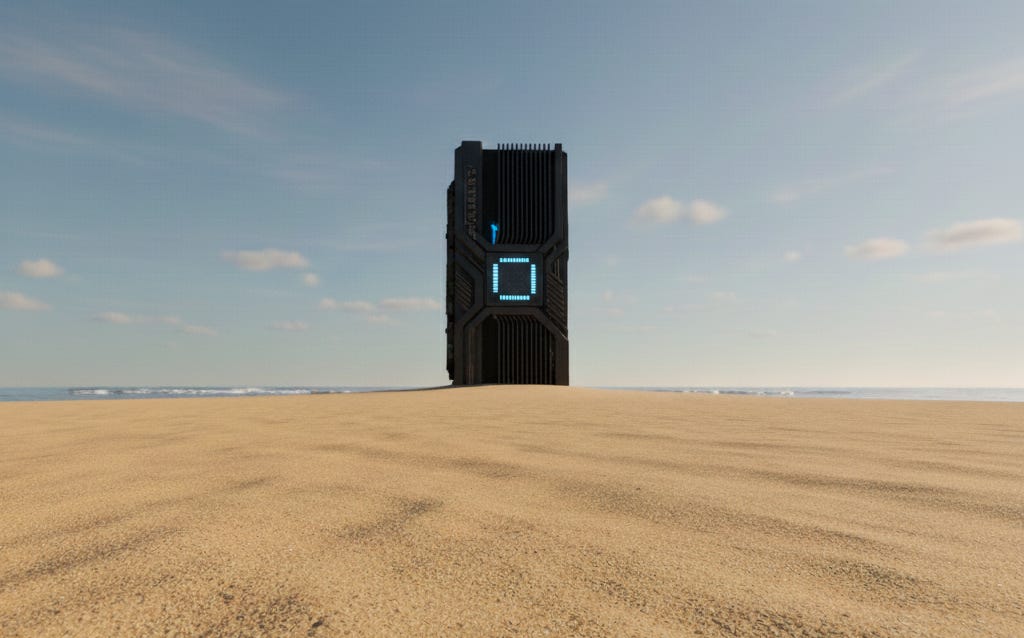
The AI economy begins with sand. TSMC takes silicon dioxide, literally beach sand, and through $20 billion fabrication plants transforms it into chips worth 10,000x the raw material cost. Nvidia takes those chips and turns them into H100 GPUs selling for $30,000 apiece. Microsoft takes those GPUs and rents them by the hour at 80% gross margins. OpenAI takes that compute and burns it training models they sell through APIs at a loss. And somewhere, theoretically, an enterprise customer takes that API access and builds an application that generates actual economic value.
This is the five-tier value chain of AI:
silicon → GPUs → cloud → models → applications
In a functioning market, each tier captures margin by adding differentiation. In the AI market, only Tier 1 is making money. Everything else is playing hot potato with credit lines, hoping the music doesn’t stop before the applications tier materializes.
Peter Thiel sold $100 million in Nvidia stock on November 9th, mere days before their earnings call. Michael Burry bought put options betting Nvidia crashes to $140 by March 2026. Both are reading the same balance sheets you should be.
Context and Background
Tier 2 reveals the structural problem when you strip away the narrative. Nvidia reported $19.3 billion in profit for Q3. They generated $14.5 billion in actual cash. That $4.8 billion gap is is so far from a rounding error it’s basically Voyager 1, calling in from a full light-day away. The widespread pattern across Mag7 is revenue being booked before money changes hands. Healthy chip companies like TSMC and AMD convert over 95% of reported profits into cash. Nvidia converts 75%. The gap gets filled with $33.4 billion in unpaid bills (up 89% year-over-year) and $19.8 billion in unsold inventory (up 32%).
Obvious round-tripping is obvious: Nvidia invests $2 billion in xAI. xAI borrows $12.5 billion to buy Nvidia chips. Microsoft gives OpenAI $13 billion. OpenAI commits $50 billion to buy Microsoft cloud. Microsoft orders $100 billion in Nvidia chips to build that cloud. Oracle extends $300 billion in cloud credits to OpenAI. OpenAI orders Nvidia chips for Oracle data centers. In November, Microsoft and Nvidia poured $15 billion into Anthropic, valuing it at $350 billion, triple the $183 billion valuation from their September Series F! Nvidia is simultaneously investing $5 billion in Intel and $10 billion more in Anthropic.
Call it strategic partnerships if you want. Well, sure, whatever. The accounting structure is identical to Enron’s special purpose entities: circular flows where everyone is simultaneously creditor and debtor, booking forward orders as revenue, using GPU allocations as a form of credit. The system stays upright through forward momentum. The moment someone downstream can’t convert compute into paying customers, the circle breaks and the unpaid bills become writedowns.
The tier economics reveal where value is actually trapped versus where everyone thinks it’s being created. Tier 1 (silicon fabrication) has real margins and real cash generation; TSMC’s order book is full three years out, and even if competitors could build fabs, it takes three years and $20 billion per plant. Tier 2 (GPUs) looks profitable but that 75% cash conversion rate means Nvidia is booking revenue faster than collecting payment. Tier 3 (cloud) reports growth while simultaneously being its own largest customer: Microsoft “sells” cloud to OpenAI using Microsoft’s own investment capital, recording revenue despite cash never leaving the loop. Tier 4 (models) burns $3-5 for every $1 of revenue generated. Tier 5 (applications) barely exists at scale.
The unit economics make this explicit. America is deploying $400 billion per year in AI capex right now. For this not to be a bubble, we need $400 billion-plus in annual revenue from Tier 5 by decade’s end. OpenAI and Anthropic are spending roughly $100 billion in capex (indirectly, through Microsoft and Amazon). Their combined 2025 revenue: $20 billion. That’s a 5:1 capex-to-revenue ratio, which works in hypergrowth markets if and only if the infrastructure being built today generates enough lifetime value to exceed its construction costs before it becomes economically obsolete.
Here’s where capex and opex tensions collide with tier economics. Traditionally, infrastructure is capex: you buy it, own it, depreciate it over five years, extract value across its economic life. AI infrastructure is moving too fast for this model. H100s launched in 2023. H200s shipped in 2024. Blackwell is ramping now. Your $30,000 GPU is economically obsolete in 18 months but depreciated over 60 months. The gap between book value and market value compounds every quarter, which is why nobody can answer the Reddit thread asking where data centers are dumping old GPUs; admitting you’re replacing hardware after two years destroys the depreciation fiction holding your P&L together.
The major labs handle this by treating infrastructure like capex on paper (stretching depreciation timelines to smooth reported costs) while treating it like opex practically (maintaining flexibility to swap hardware on rapid cycles). It’s not illegal, but it creates a systemic mismatch between reported profits and cash generation. When 45% of fund managers tell Bank of America that an AI bubble is their biggest tail risk, they’re not worried about model benchmarks. They’re worried about what happens when depreciation schedules collide with replacement reality and someone takes a writedown large enough to spook the index funds auto-allocating into these positions. These are the actual bubble dynamics.
Bubblenomics: Ideology, Formatted in Excel
OpenAI’s $1.5 trillion credit card is maxed out. CEO Sam Altman has projected spending commitments exceeding $1.4 trillion over the next several years, creating a shortfall of roughly $1.2 trillion against current cash reserves. They had $3.5 billion in revenue against $5.3 billion in operating losses in 2024. First half of 2025: $4.3 billion in revenue, $7.8 billion in losses. Third quarter alone: $12 billion in losses. (I’m literally LOLing here.) They’re projecting $115 billion in cumulative burn by 2029, at which point they claim profitability. The Financial Times calculates OpenAI needs to raise at least $207 billion by 2030 just to continue operating at current burn rates. For their valuation to hold, their $20 billion in current revenue must grow 32x to $650 billion in five years while their flagship model ranks 95th on benchmarks.
Altman’s rookie moves aren’t helping. Last month he announced Stargate would consume 40% of global DRAM supply. Prices rocketed 3x before he secured funding or supply contracts, making his own infrastructure roadmap 3x more expensive by telegraphing demand without locking in capacity. This is what happens when tech guys pretend they understand finance and finance guys pretend they understand tech: spectacular self-owns where a CEO inadvertently reprices his entire capex plan.
Anthropic and OpenAI represent two ideological responses to the same tier economics, and their divergence reveals which parts of the value chain each believes will capture sustainable margin. In 2025, both ran roughly 70% burn ratios: OpenAI at $13 billion revenue with $9 billion in net operating losses, Anthropic at $4.2 billion revenue with $3 billion in net losses. By 2028, Anthropic’s base case projects breakeven. OpenAI’s base case shows a $74 billion net loss. Faites vos jeux.
Anthropic is betting on unit economics and composable profitability: monetize the present, then scale it. (My kind of company, obvi.) They’re running an 80% enterprise customer mix, pruning expensive modalities like video generation, optimizing for high annual contract values with predictable renewal rates. It’s a SaaS playbook, build a defensible Tier 4 position, expand from there, and never spend more than you can explain to a CFO without a deck. Capital efficiency buys strategic flexibility: the freedom to raise less, spend more, or survive a capital winter. Or BTC $50,000.
OpenAI is betting on narrative convexity and pre-emptive scale: build the future, then monetize it. Their burn is a portfolio of call options on video (Sora), consumer products (ChatGPT), browsing infrastructure (Atlas), agents, robotics, and multi-year compute commitments. The logic is ok if you really squint: secure Tier 3 capacity now, build Tier 5 product optionality across modalities, and scale into whichever surfaces show traction. Standard VC Vegas style approach. If it works, you own tiers 3 through 5. If it doesn’t, you’re holding stranded capital in the form of unused cloud credits and hardware commitments you can’t unwind. OpenAI is selling the promise of a future where they control the energy grid and possibly your therapist. Anthropic is selling predictability. Both are ostensibly rational. Only one can be right at current burn rates.
Industry Impact
The “Magnificent 7” plus 34 data-center ecosystem companies account for 75% of S&P 500 returns since October 2022, 80% of earnings growth, and 90% of capital spending growth.
Power has already shifted from Tier 4 (models) to Tier 3 (cloud infrastructure) and is consolidating back toward Tier 1 (silicon fabrication). Google released Gemini 3 (November 18) with genuine reasoning improvements but at 8x to 16x the cost of GPT-5.1 Thinking on input and 6x to 9x on output. Within days, Anthropic shipped Opus 4.5. Qwen matched frontier performance with 3 billion active parameters, small enough to run on a single H100. \o/ Model quality is converging. The differentiation is collapsing at Tier 4, which means margin capture is moving to whoever controls Tier 3 (compute access and cloud commitments) and Tier 5 (enterprise distribution and application value.)
Google could collapse Tier 2 margins tomorrow by making TPUs commercially available at scale and reasonable pricing. Nvidia’s dominance would end, compute would become a commodity, and the entire capex buildout predicated on GPU scarcity would turn into stranded assets. This hasn’t happened because Google benefits from Nvidia’s pricing power, it limits how fast competitors can scale. But the threat is structural, and it means every multi-year compute commitment is a bet on market structure as much as technical capability.
The lasting value might not be the models or even the GPUs but in the industrial capability itself. The dot-com bubble left us fiber in the ground that enabled the internet economy. (Though its undersea siblings are somewhat at risk.) Crypto mining built Crusoe, which is now constructing Stargate for OpenAI on stranded natural gas infrastructure in Abilene. If AI is a bubble, what survives is Tier 1 and the power infrastructure: the fabrication plants, the supply chains, the buildings that can deploy massive compute on demand. The GPUs are worthless after three years, but datacenters are forever (well, decades, anyway.)
What This Means for CTOs
Your infrastructure decisions are bets on which tier thrives when capital markets turn hostile. The reveal everyone else is missing: the model is becoming the feature, and the infrastructure around it is becoming the business. Tier 4 differentiation is collapsing. The moat is moving to Tier 3 (who controls compute access) and Tier 5 (who converts intelligence into business value). OpenAI’s business plan is based on the reverse premise, tho (in fact they can’t survive unless Tier 5 collapses into Tier 4.) You need to architect for scenarios where your primary vendor’s Tier 4 position evaporates, their Tier 3 commitments become stranded capital, or their cash conversion problems force sudden repricing.
Capex versus opex is the immediate decision point. If you treat AI infrastructure as capex, you’re locked in when technology shifts; stuck depreciating assets that are economically obsolete in 18 months. If you treat it as opex, tho, your CFO sees spiraling costs with no asset value. The right answer depends on which replacement cycle assumptions pan out. If model improvement continues at current pace, treat it as opex and preserve flexibility. If it plateaus, capex gives you predictable costs. Most CTOs are optimizing for this quarter’s budget conversation instead of next year’s architectural constraints. Don’t be one of them.
Multi-vendor strategies are mandatory. Anthropic’s capital efficiency means they’ll survive if funding windows close. OpenAI’s compute commitments mean they’ll have capacity if demand materializes. Your job isn’t picking the winner, it’s avoiding an all-in bet on either future. (Unless you’re company is exceptionally un-risk-adverse.) Abstract model selection behind orchestration layers, maintain fallback paths, and stress-test dependencies for scenarios where your primary vendor’s pricing power collapses or credit lines get pulled.
The second-order risk is Tier 3 collateral damage. If OpenAI or Anthropic stumbles, Microsoft and Amazon absorb it. If Nvidia’s inventory becomes writedowns, it cascades through every tier. Your SaaS vendors on Azure OpenAI or AWS Bedrock might face sudden price increases, service degradations, or forced migrations as underlying providers reprice risk. You can’t predict which tier fails first, but you can architect flexibility to survive any of them failing.
You’re not building on models. You’re building on a tier structure where economic value is trapped three layers below the API you’re calling, and the tiers above it are playing hot potato with credit lines. The round-tripping will continue until morale improves.
CTO Playbook: 30/60/90
Capital Risk Hedge
OKR: Structure your AI infrastructure strategy as a financial portfolio designed to hedge against depreciation fiction, vendor lock-in, and Tier 4 commoditization.
30 Days: Auditing and Cash Flow Resilience
Uncovering financial exposure stemming from GPU depreciation and vendor-subsidized debt.
Recalculate Economic Obsolescence (CRITICAL)
Action: Re-evaluate your current AI infrastructure (GPUs, specialized hardware) using an 18-month economic life cycle instead of the standard 60-month depreciation schedule. Calculate the difference between the book value and the actual replacement value.
Goal: Present the CFO with the true, accelerated depreciation liability to force a conversation about treating AI infrastructure as OPEX, not CAPEX.
Audit Vendor Subsidies (HIGH)
Action: Analyze all cloud credits and multi-year compute commitments received from Tier 3/4 vendors (Microsoft, Google, Anthropic). Determine the cash cost if those vendors pulled their investment/subsidy lines or repriced their services overnight.
Goal: Identify where your application’s current unit economics are being falsely subsidized by the vendors’ round-tripping capital, which creates the highest operational risk.
Abstract Model Selection (HIGH)
Action: Mandate that all new AI applications and workflows be abstracted behind a standard orchestration layer (e.g., LangChain, custom service). Ban hard-coded API dependencies on a single Tier 4 model (e.g., GPT-5.1 Thinking).
Goal: Hedge against Tier 4 commoditization. Ensure the business can rapidly switch models when a better, cheaper alternative (like Qwen, or a new Anthropic release) emerges, preserving model choice and negotiating leverage.
□ 60 day: Tier-Agnostic Architecture & Flexibility
Architectural bets prioritizing portability & resilience against specific Tier collapse (2, 3, or 4).
Build a Compute Arbitrage Strategy (MEDIUM HIGH):
Action: Begin piloting non-hyperscaler compute options (e.g., Oracle, specialized GPU cloud providers, bare metal) for non-critical workloads.
Goal: Develop an internal capability to arbitrage GPU scarcity and pricing outside of the primary Tier 3 vendors (Microsoft/Amazon), hedging against a structural collapse of Nvidia’s pricing power.
Define a Multi-Vendor Model Strategy (MEDIUM)
Action: Formally designate fallback models for critical business functions. For every Tier 4 model used, identify a Tier-4 competitor and an Open Source/Fine-Tuned model as a viable contingency path.
Goal: Avoid an all-in bet on either the OpenAI (Scale) or Anthropic (Efficiency) ideological future, ensuring survival regardless of who wins the capital race.
Inventory Stranded Assets (MEDIUM)
Action: Document all current and future multi-year cloud commitments and hardware leases. Calculate the stranded capital liability if model improvement stops or Tier 4 differentiation completely evaporates in the next 12 months.
Goal: Prepare for the possibility of a large write-down and maintain the flexibility to avoid new long-term commitments.
□ 90 Days: Structural Investment & Value Capture
Long-term investment in the stable layers of the value chain: Tier 1 (Capability) & Tier 5 (Apps)
Invest in Tier 5 Value Capture (HIGH STRATEGY)
Action: Shift development resources away from optimizing model calls (Tier 4) toward integrating AI into proprietary workflows and distribution channels (Tier 5).
Goal: Ensure your applications capture the final, sustainable margin in the value chain, making your business resilient regardless of which model vendor survives.
Initiate Industrial Capability Planning (MEDIUM STRATEGY)
Action: Begin preliminary analysis on the long-term utility of physical infrastructure (datacenter leases, power infrastructure, cooling). Analyze these assets as deca-long investments rather than three-year compute investments.
Goal: Align your spending with the lasting value identified in the section—the industrial capability itself—not the transient value of the GPU or the model.
Hedge the Crypto-AI Cascade (LOW STRATEGY)
Action: If your business has exposure to crypto (either through payments, treasury, or investment), run a stress test simulating a 40% drop in Nvidia stock (triggering loan defaults) followed by a 50% crash in Bitcoin (the cascade risk).
Goal: Be prepared for the systemic, narrative shock where AI infrastructure bets and crypto leverage collapse together, disrupting capital markets and investment windows.
The Bottom Line
Your infrastructure stack is not a technology decision; it is a financial arbitrage bet against market reality. You are wagering that the GPU you buy today, which will be economically obsolete in 18 months, will generate enough Tier 5 revenue before its replacement is required. This calculation fails every stress test. The value is not in the models you call or the GPUs you buy. It is trapped in Tier 1 (fabrication) and the industrial capability itself.
The final reveal is that the structural mismatch, where infrastructure is treated as CAPEX on paper but demands OPEX flexibility operationally, guarantees a massive, systemic writedown when depreciation schedules collide with replacement reality. You cannot build a multi-year business on a system predicated on accounting fiction.
Your job is not to pick the winner between OpenAI and Anthropic, but to survive the inevitable capital correction. Treat AI infrastructure as OPEX to preserve the flexibility to swap hardware on an 18-month cycle. Shift resources from Tier 4 (model tinkering) to Tier 5 (proprietary application value), which is the only place margin is captured sustainably. The entire ecosystem is operating on a high-leverage credit line called “narrative convexity.” The moment the music stops, you need to ensure your Tier 5 applications are generating enough real economic value to pay the bills for the infrastructure Tier 3 subsidized. If you haven’t captured Tier 5, you’re just another creditor in the collapse.
The round-tripping will not stop until morale improves, or until the market finally sends the writedown large enough to force reality onto the balance sheets.
To attend CTO Lunches, please register at ctolunches.com and choose NYC as your city.